
Live performance
Measured frame rate over active test time
Interactive stress lab
Animated, draggable objects add a controllable rendering workload
Measurements are local to this browser tab. Browser FPS depends on display refresh rate, background activity and hardware; it is not a standardized device benchmark. The test does not upload data.
Free Online FPS Test: Check Your Browser’s Performance in Real Time
Smooth animations, responsive scrolling, and consistent frame rates make a noticeable difference in how a computer or smartphone feels. Whether you are gaming, browsing, working with graphics, or troubleshooting a slow device, understanding frame rate performance can help you identify potential problems.
The TestMySpec Online FPS Test provides a convenient way to measure browser animation performance without downloading software or installing a desktop application.
Using the interactive FPS monitor above, you can observe real-time frame rates, analyze performance fluctuations, and test how your browser responds to increasingly demanding animations.
Unlike a basic FPS counter that only displays a number, this performance testing tool combines live statistics, visual performance graphs, and an interactive stress-testing environment.
You can monitor average, minimum, and maximum FPS, gradually increase the animation workload, and save your results for later comparison.
The entire testing process runs directly in your browser, making it accessible on compatible Windows computers, MacBooks, Linux systems, Android devices, and iPhones.
However, browser FPS measurements should not be confused with actual gaming benchmarks. This tool evaluates browser animation timing and rendering responsiveness rather than measuring the frame rate of an external game.
Understanding that distinction helps you interpret the results accurately and make better decisions about your device’s performance.
What Is an FPS Test?
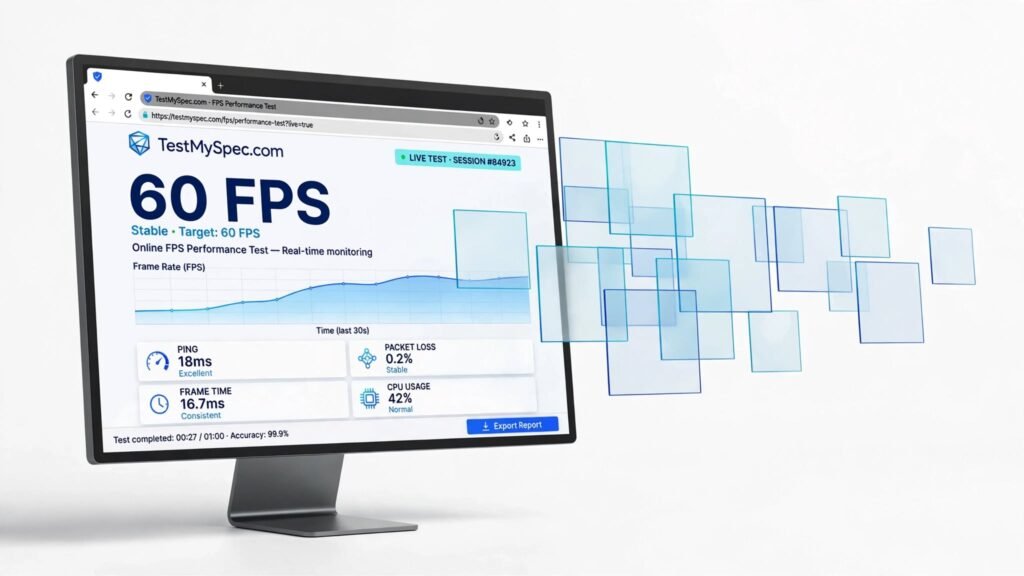
FPS stands for Frames Per Second, a measurement describing how many individual visual frames are displayed or processed during one second.
When an animation runs at 60 FPS, it updates approximately 60 times every second. At 120 FPS, it updates around 120 times per second.
Generally, higher and more consistent frame rates create smoother visual movement.
However, FPS alone does not describe the entire viewing experience. Frame delivery consistency, display refresh rate, system responsiveness, and rendering delays also influence perceived smoothness.
An FPS test measures frame delivery under a particular workload.
Different tests can measure different aspects of performance. For example, a gaming benchmark may measure frames produced by a game’s rendering engine, while an online browser FPS test typically measures animation callbacks or rendered browser updates.
The TestMySpec monitor uses browser animation timing to provide a practical view of how consistently your browser can update an interactive scene.
This makes it useful for investigating browser animation performance, comparing conditions, and observing changes when additional visual work is introduced.
Why FPS Matters
Frame rate affects several common activities:
- Gaming: Consistent frame delivery helps movement appear smooth and can improve responsiveness.
- Web browsing: Smooth animations and scrolling make websites feel more responsive.
- Video editing: Preview performance can influence how comfortably you work with demanding projects.
- Interactive websites: Applications with animated elements benefit from stable rendering.
- Device troubleshooting: Unexpected FPS drops can reveal performance interruptions that deserve further investigation.
It is important to remember that a high FPS number is not always better than a slightly lower but more consistent result.
For example, an animation fluctuating between 30 and 100 FPS may feel less stable than one maintaining a steady 60 FPS.
That is why TestMySpec provides multiple performance measurements rather than relying on a single FPS reading.
How to Use the TestMySpec Online FPS Monitor
Running a browser FPS test requires only a compatible browser and a few simple steps.
Step 1: Start the FPS Test
Locate the performance monitor above this article and click the Start button.
The tool begins recording animation frame timing and displays your current FPS.
Allow the test to run for approximately 15 to 30 seconds before evaluating the results.
A longer observation period helps distinguish normal fluctuations from sustained performance problems.
Step 2: Monitor Live FPS Statistics
The dashboard displays four important measurements:
- Current FPS
- Average FPS
- Minimum FPS
- Maximum FPS
These values help explain how your browser performs throughout the testing session.
Instead of judging your device by a single number, compare the average reading with the minimum and maximum values.
Large differences can indicate inconsistent frame delivery.
Step 3: Analyze the Performance Graph
The live performance graph visualizes FPS changes over time.
A relatively flat line generally indicates consistent frame delivery.
Repeated downward spikes can indicate slower intervals, while frequent fluctuations suggest changes in workload or browser scheduling.
Observe the graph before increasing the testing workload so that you have a useful baseline.
Step 4: Run the Interactive Stress Test
The stress-testing area contains moving objects that create additional animation work.
Use the available controls to add more objects.
As the number of animated objects increases, observe whether the FPS remains steady or begins dropping.
You can also interact with the shapes by dragging them across the testing area.
This provides a more demanding test than simply watching an FPS counter.
Step 5: Adjust the Testing Conditions
Depending on the workload you want to examine, increase or decrease the number of animated objects and change their motion speed.
For meaningful comparisons, adjust one setting at a time.
For example, compare the results with 50 animated objects against a second session using 150 objects at the same motion speed.
Step 6: Pause, Reset, or Export Results
Use the pause or stop control to interrupt monitoring without unnecessarily continuing the measurement.
Reset the tool when you want to begin a fresh experiment.
The monitor also supports downloadable reports, including PDF summaries and CSV exports, so you can preserve your measurements and compare them later.
Understanding Your FPS Test Results
Each FPS measurement describes a different aspect of browser performance.
Understanding these values is essential before deciding whether a device is performing well.
Current FPS: Your Latest Performance Reading
Current FPS represents the most recently calculated frame rate.
This value updates during testing and can change as the browser handles additional tasks.
For example, if your browser is running near 60 FPS and you suddenly add several hundred animated objects, the current reading may temporarily decrease.
Short fluctuations do not necessarily indicate a hardware problem.
Background activity, browser scheduling, display synchronization, and changes in rendering workload can all influence the number.
Current FPS is best used to observe immediate changes rather than provide a final performance rating.
Average FPS: Overall Session Performance
Average FPS summarizes the sampled frame rates collected during the test.
Suppose your browser produces these readings:
58 FPS, 60 FPS, 59 FPS, 57 FPS, and 61 FPS.
The average would be:
Average FPS = (58 + 60 + 59 + 57 + 61) ÷ 5 = 59 FPS
This tells you that the browser maintained approximately 59 FPS across those samples.
Average FPS is useful when comparing repeated tests under similar conditions.
However, a good average cannot guarantee perfectly smooth animation.
A session containing occasional severe slowdowns may still produce a relatively high average.
Minimum FPS: Identifying Performance Drops
Minimum FPS is the lowest sampled frame rate recorded during the session.
For example, your browser might average 60 FPS but briefly fall to 25 FPS.
That low reading suggests that the browser experienced a slower measurement interval.
Possible causes include competing system activity, increased animation workload, operating-system interruptions, or browser rendering delays.
One unusually low sample does not prove that the computer is defective.
Repeated low readings under similar conditions are more useful evidence.
Maximum FPS: Peak Observed Performance
Maximum FPS represents the highest sampled reading recorded during the test.
A browser running on a 60 Hz display will often produce readings near 60 FPS because animation callbacks are commonly synchronized with screen refresh opportunities.
A maximum near 60 FPS therefore does not automatically mean that your GPU is incapable of producing higher frame rates.
The display configuration and browser timing behavior must be considered.
FPS Performance Comparison: 30, 60, 120, 144, and 240 FPS
Different frame rates provide different levels of temporal smoothness.
| Frame Rate | Approximate Frame Time | Typical Experience |
|---|---|---|
| 30 FPS | 33.33 ms | Acceptable for some basic animations and games |
| 45 FPS | 22.22 ms | Smoother than 30 FPS, but below 60 FPS |
| 60 FPS | 16.67 ms | Smooth experience on many standard displays |
| 90 FPS | 11.11 ms | More frequent updates on compatible displays |
| 120 FPS | 8.33 ms | Very smooth motion with suitable hardware |
| 144 FPS | 6.94 ms | High-refresh-rate experience |
| 165 FPS | 6.06 ms | Frequent updates on supported displays |
| 240 FPS | 4.17 ms | Extremely frequent updates on compatible systems |
These frame times assume steady frame delivery.
A 120 FPS average does not mean every frame necessarily arrives exactly 8.33 milliseconds after the previous one.
Real-world timing can fluctuate.
For browser testing, the display’s refresh rate frequently determines the maximum observable animation update rate.
If your display supports 144 Hz but the browser reports approximately 60 FPS, check whether the operating system is actually using the higher refresh rate.
You can investigate your screen settings using the TestMySpec Refresh Rate Tester.
FPS vs Refresh Rate: What Is the Difference?
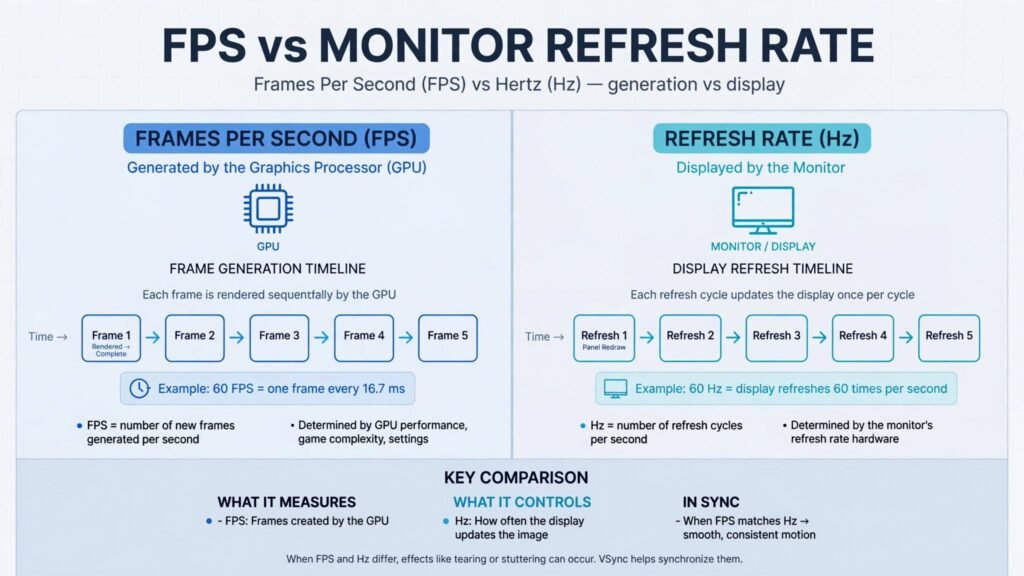
FPS and refresh rate are closely related, but they measure different things.
FPS measures the rate of frame generation or delivery. Refresh rate measures how frequently a display refreshes its image.
Refresh rate is expressed in hertz (Hz).
A 60 Hz display refreshes approximately 60 times each second, while a 144 Hz display can refresh approximately 144 times per second.
A powerful computer may generate more frames than a display can present as distinct full-screen updates.
Similarly, a high-refresh-rate monitor cannot create missing animation frames when an application updates slowly.
Example: 60 FPS on a 144 Hz Monitor
Imagine you own a monitor configured for 144 Hz.
If your browser animation only updates 60 times per second, the display may refresh more frequently than the content changes.
The result may look less fluid than an animation consistently updating near 144 FPS.
However, several factors influence browser frame delivery, including power-saving settings, synchronization behavior, and application workload.
Can an Online FPS Test Measure Monitor Refresh Rate?
An online animation test can help estimate display-timing behavior, but it is not a direct hardware measurement.
Browser timing can be affected by operating-system and browser restrictions.
For a more focused test, use our free online refresh rate checker, which includes display timing and jitter measurements.
Combining both tools provides a clearer view of browser animation smoothness and display refresh behavior.
What Is Frame Time, and Why Is It Important?
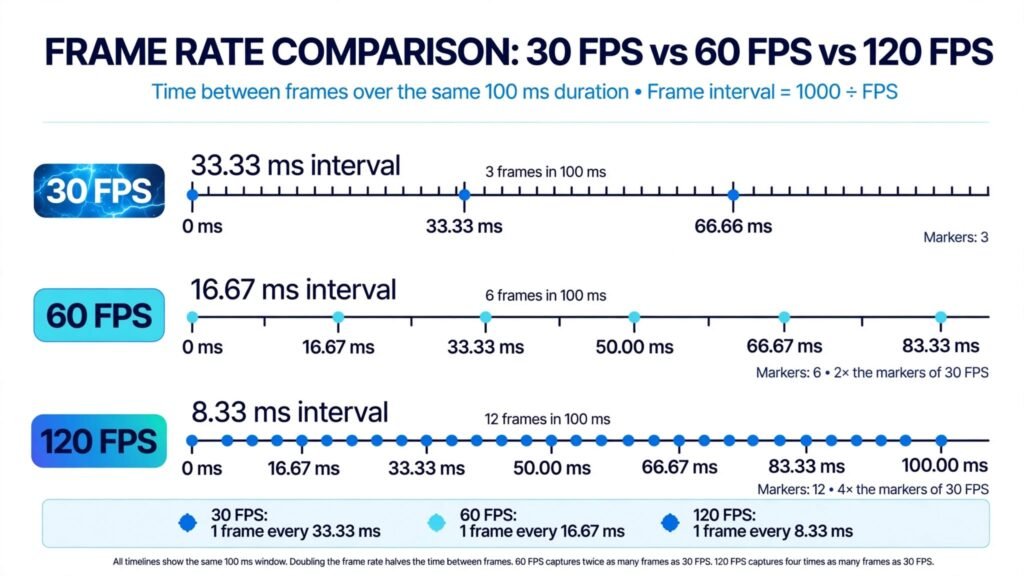
Frame time describes the interval associated with producing or displaying an individual frame.
It is usually measured in milliseconds.
The basic relationship is:
Frame Time (ms) = 1,000 ÷ FPS
At 60 FPS, the average interval between evenly spaced frames is approximately 16.67 milliseconds.
At 120 FPS, that interval becomes approximately 8.33 milliseconds.
Lower frame times allow visual updates to occur more frequently.
However, consistency matters.
Consider two animations that both average 60 FPS.
The first delivers frames at approximately equal intervals. The second alternates between very short intervals and occasional long delays.
Although both may average 60 FPS, the second animation can appear noticeably less smooth.
This phenomenon is often described as frame pacing inconsistency.
What Causes Frame-Time Spikes?
Frame-time spikes occur when an individual frame or interval takes longer than expected.
Common causes include:
- Heavy JavaScript execution
- Browser layout and painting work
- GPU rendering delays
- Memory management interruptions
- Competing background processes
- CPU scheduling delays
- Power-management changes
An FPS graph can reveal periods of reduced performance, but a one-second sampling interval cannot identify every individual long frame.
For detailed frame-level investigation, browser developer tools provide more precise performance profiling.
How the Interactive FPS Stress Test Works
The TestMySpec stress test uses animated objects to create a repeatable browser workload.
Instead of running a complex 3D game, the testing area animates multiple shapes inside a canvas.
Each object needs its position updated and then represented visually.
Increasing the object count introduces additional work for the browser.
The test helps you observe how animation responsiveness changes as that work increases.
Light Stress Testing
Begin with a relatively small number of moving objects.
For example, start with 10 to 50 shapes and record the average FPS.
On a modern computer, this may represent a relatively light workload, although the results depend on the device and browser.
Watch the graph to establish a baseline.
Moderate Stress Testing
Add more objects and compare the readings.
For example, increase the number of shapes from 50 to 150 while keeping motion speed unchanged.
If the average FPS stays consistent, your browser is maintaining its animation update rate under that particular load.
If the graph becomes unstable, you may be approaching a workload that the browser cannot process as consistently.
Heavy Stress Testing
Continue increasing the number of animated objects within the tool’s supported limits.
Watch for sustained FPS reductions rather than focusing only on a brief dip.
A heavy stress test can help reveal performance sensitivity to animation workload.
However, the results should not be treated as a standardized graphics-card benchmark.
Modern games involve significantly more complex operations, including textures, lighting, geometry, shaders, physics, and other processing.
The browser stress test evaluates a specific canvas animation workload, not the full capabilities of a gaming GPU.
Why Is My FPS Stuck at 60?
A reading close to 60 FPS is common and often completely normal.
Several factors can explain why your browser does not report a higher value.
Your Monitor May Be Running at 60 Hz
Even if your monitor supports 120 Hz or 144 Hz, the operating system might currently be configured for 60 Hz.
Check the display settings and select the intended refresh rate when supported.
For example, Windows users can inspect the advanced display settings to find the active refresh rate.
Browser Animation Synchronization
Modern browsers commonly schedule animation callbacks using requestAnimationFrame.
These callbacks are generally synchronized with display repaint opportunities.
Consequently, the browser may update an animation approximately 60 times per second when operating on a 60 Hz display.
This does not mean the graphics card itself is limited to 60 FPS.
Power-Saving Settings
Battery-saving modes may reduce display refresh rate or system performance.
Some laptops automatically switch to more conservative display settings when disconnected from power.
Mobile devices can also change refresh behavior dynamically.
Browser or Operating-System Restrictions
Different browsers and operating systems may apply different animation timing policies.
Running the same test in another browser can sometimes produce different results.
For an additional check, compare your reading with the TestMySpec monitor refresh rate test.
Why Does My FPS Keep Dropping?
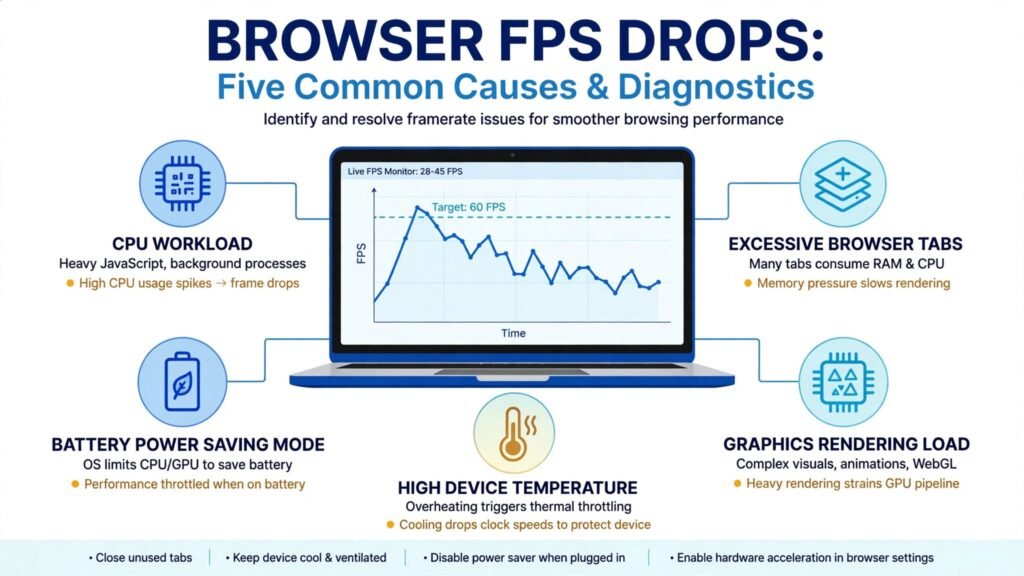
FPS drops can occur when the browser temporarily fails to maintain its previous animation update rate.
The cause may be simple or require further investigation.
Too Many Background Applications
Browsers share CPU and GPU resources with other applications.
Video meetings, editing software, games, and resource-heavy browser tabs can compete for processing time.
Try closing unnecessary applications before repeating the test.
If performance becomes more consistent, background resource usage may have contributed.
Thermal Throttling
Processors and graphics chips generate heat while operating.
When temperatures become excessive, a device may reduce its operating speed to protect internal components.
This can lead to lower performance during sustained workloads.
Thermal throttling is especially relevant to laptops and smartphones with limited cooling capacity.
An FPS test cannot directly confirm overheating, but consistent performance deterioration during longer tests may justify checking temperatures.
Outdated Browser or Graphics Drivers
Older software versions may contain rendering bugs or compatibility problems.
Keeping your browser and graphics drivers updated can help maintain reliable rendering behavior.
Update software through official channels and restart the browser before repeating the experiment.
Hardware Acceleration Problems
Browsers can use graphics hardware to accelerate supported rendering operations.
Some systems experience performance problems when hardware acceleration is unavailable or when graphics drivers behave unexpectedly.
Check your browser’s graphics settings and troubleshoot cautiously.
Changing hardware acceleration is not a universal fix, and different devices may respond differently.
Power Management and Battery Condition
Laptops and smartphones may restrict performance to conserve energy.
If performance changes significantly between plugged-in and battery operation, review your device’s power settings.
For additional information about available browser battery indicators, you can also explore the TestMySpec Battery Health Tester.
Battery information exposed to websites is limited, so browser-based battery results should not replace manufacturer diagnostics for actual battery capacity or condition.
How to Improve FPS and Browser Performance
If your FPS readings are consistently lower than expected, several practical adjustments may help.
1. Update Your Browser
Use a current version of Chrome, Edge, Firefox, Safari, or another compatible browser.
Browser updates can include improvements to performance, rendering, and stability.
2. Close Unnecessary Tabs
Some websites continue running scripts and background tasks.
Closing heavy tabs can reduce resource competition.
This is particularly useful on devices with limited memory.
3. Check Your Display Settings
Verify that your monitor is configured for its intended refresh rate.
A higher-refresh-rate display running in a lower mode may not deliver the smoothness you expect.
4. Review Power Settings
Power-saving modes can affect CPU, GPU, and display behavior.
For repeatable testing, keep the same power configuration between sessions.
5. Maintain Proper Cooling
Keep laptop ventilation openings clear and avoid placing the device on surfaces that obstruct airflow.
Excessive heat can reduce sustained performance.
6. Reduce Competing Workloads
Pause intensive background tasks when testing.
Large software installations, video rendering, and other demanding workloads can interfere with consistent measurements.
7. Compare Multiple Browsers
Different browsers may handle the same animation differently.
Repeat the test using the same object count, motion speed, window dimensions, and power settings.
8. Restart Before Retesting
If your system has been running demanding applications for several hours, restarting can help remove some temporary software-related problems.
A restart is not guaranteed to improve performance, but it can be a useful troubleshooting step.
How to Get More Accurate Online FPS Test Results
Meaningful performance testing requires consistent conditions.
A single measurement can be influenced by unrelated tasks or temporary interruptions.
For better comparisons, use the following method.
First, establish a baseline. Run the monitor without adding excessive stress objects and record the average FPS.
Second, use a fixed duration. A 30-second or 60-second test provides a more meaningful comparison than stopping each session at a different time.
Third, maintain consistent settings. Use the same browser, screen refresh rate, window size, animation speed, and object count.
Fourth, repeat the test. Run the same workload several times to identify whether the result is consistent.
Fifth, compare trends rather than isolated peaks. A stable average and fewer large drops often provide better information than a single maximum FPS reading.
If you are comparing multiple devices, record their operating systems, display refresh rates, and power configurations.
A browser running at 60 FPS on a 60 Hz laptop cannot be fairly compared by raw FPS alone with another browser running at 144 FPS on a 144 Hz desktop.
The displays provide different animation timing opportunities.
Online FPS Test vs Gaming FPS Counter
Although both display FPS measurements, an online browser FPS test and an in-game FPS counter serve different purposes.
| Feature | Browser FPS Test | In-Game FPS Counter |
|---|---|---|
| Measures | Browser animation performance | Frame delivery within a game |
| Installation | Usually unnecessary | Depends on game or software |
| Stress testing | Browser animation workload | Game-specific workload |
| Live FPS reading | Yes | Usually |
| Display refresh influence | Commonly significant | Depends on game settings |
| GPU gaming benchmark | No | Possible with suitable testing |
| Cross-device access | Broad browser compatibility | Game and platform dependent |
Can a Browser FPS Test Predict Gaming Performance?
Not reliably.
A browser running smoothly at 60 FPS does not prove that demanding games will also achieve 60 FPS.
Games use different rendering technologies, graphics settings, resolutions, and processing workloads.
For example, a laptop may run a simple canvas animation smoothly but struggle with a modern game at high graphical settings.
The reverse is also possible: a capable gaming PC may produce unexpected browser animation results because of display synchronization or browser-specific limitations.
Use browser FPS testing to evaluate browser animation behavior.
Use an actual game benchmark to evaluate gaming performance.
Testing FPS on Windows, macOS, Linux, and Smartphones
TestMySpec works through compatible web browsers, making the monitor useful across different device categories.
Windows PCs and Gaming Laptops
Windows users can compare results across browsers such as Chrome, Edge, and Firefox.
Before testing, inspect the configured display refresh rate and keep power settings consistent.
If you use several monitors, perform the test on the same display each time.
MacBooks and Mac Desktops
Mac users can run browser-based animation tests through compatible browsers.
Some MacBook models support adaptive refresh rates, while others use fixed refresh configurations.
For repeatable results, consider the active display mode and power conditions.
Linux Computers
Linux users can also measure browser animation performance.
Results can vary based on desktop environment, graphics drivers, browser configuration, and display server behavior.
Comparisons are most useful when these conditions remain unchanged.
Android Smartphones
Android devices often use dynamic refresh rates to balance smoothness and battery consumption.
Some phones automatically switch between refresh modes depending on activity.
As a result, FPS readings may differ even when the hardware supports a higher refresh rate.
iPhones and iPads
Compatible browsers on iPhones and iPads can run animation tests.
However, platform-specific browser behavior and power management may influence results.
A device advertised with a high-refresh-rate display does not guarantee that every webpage animation will run at that maximum rate continuously.
How to Compare FPS Results Between Devices
Comparing two computers or smartphones requires more than observing which device displays the larger FPS number.
Start by checking whether both devices use similar refresh rates.
If one device uses a 60 Hz screen while another uses 120 Hz, their browser animation results may naturally differ.
Next, choose the same stress-test settings on both devices.
Run each test for the same duration and record the average FPS.
Look for consistent performance, large fluctuations, and the workload level at which the graph begins showing sustained reductions.
For example, two devices might both maintain approximately 60 FPS with 100 animated objects.
If one becomes unstable at 300 objects while the other remains steady, that difference may be useful when comparing how the browsers handle this animation workload.
It still does not establish a universal ranking of CPU or GPU performance.
Screen resolution, browser implementation, and other device-specific conditions can affect the workload.
Use the results as one piece of evidence rather than a definitive hardware score.
Downloading FPS Reports and Analyzing Your Data
The TestMySpec monitor includes reporting features that make it easier to preserve testing results.
PDF Performance Reports
A PDF report provides a convenient summary of the session.
Depending on the collected data, the report can include FPS statistics, testing duration, workload information, and performance observations.
PDF reports are useful when you want to keep a readable record or share results with someone helping troubleshoot your device.
CSV Performance Data
CSV files are particularly useful for comparing numerical measurements.
You can open exported CSV data in spreadsheet applications and examine recorded FPS samples.
For example, you could compare measurements from two browsers or calculate how often the sampled frame rate fell below a chosen threshold.
Keep in mind that sampled FPS values are not the same as detailed per-frame timing measurements.
Are FPS Test Results Private?
The browser monitor performs its animation measurements locally and prepares reports without requiring an account.
The measurement feature does not need to upload your FPS samples to a remote benchmarking service.
However, the surrounding website may use standard WordPress functionality or other services.
For information about website data practices, read the TestMySpec Privacy Policy.
Frequently Asked Questions About FPS Testing
What Is a Good FPS for a Computer?
A good FPS depends on the application, display refresh rate, and workload. For many everyday browser animations on a 60 Hz screen, a stable reading near 60 FPS is normal. High-refresh displays may support higher animation rates.
Is 60 FPS Good for Gaming?
Yes, 60 FPS is a common target for smooth gaming. Competitive players may prefer higher frame rates when supported by their hardware and displays. Consistency and frame pacing also matter.
Is 120 FPS Better Than 60 FPS?
A steady 120 FPS provides updates approximately twice as frequently as 60 FPS. On a compatible display, it can produce smoother motion and potentially improve responsiveness. The benefit depends on the application and device.
Why Is My FPS Low Even With a Good Graphics Card?
Browser FPS may be limited by display refresh rate, browser scheduling, CPU activity, power settings, or the specific animation workload. A powerful GPU does not guarantee an unusually high reading in every browser test.
Can I Check FPS Without Downloading Software?
Yes. The TestMySpec online FPS monitor runs directly in a compatible web browser. It measures browser animation performance rather than the frame rate of unrelated desktop applications.
Does This FPS Test Measure My GPU Performance?
It measures performance during a browser animation workload, which may involve graphics hardware. It does not isolate GPU performance or provide a standardized GPU benchmark score.
Why Does My FPS Drop When I Add More Objects?
Additional objects increase the amount of animation and drawing work. If the browser cannot maintain its previous update rate under the larger workload, measured FPS may decrease.
Can I Run an FPS Test on My Phone?
Yes. Compatible Android and iOS browsers can run the test. Mobile power management, temperature, browser restrictions, and adaptive refresh rates may affect the results.
What Is the Difference Between FPS and Hz?
FPS measures how frequently visual frames are produced or delivered. Hertz measures how often a display refreshes. The two are related but not identical.
What Does Minimum FPS Tell Me?
Minimum FPS identifies the lowest sampled frame rate during the session. It can highlight slower intervals, but a single low result does not establish the cause of the slowdown.
Does Higher FPS Always Mean Better Performance?
Not necessarily. Stable frame delivery is important, and the display must be capable of presenting the additional updates. Higher FPS may also increase power consumption.
Can I Test My Monitor’s Refresh Rate Online?
Yes. Visit the TestMySpec Refresh Rate Tester to examine estimated refresh behavior and frame timing stability.
How Long Should I Run the Test?
A short 15 to 30-second session can provide an initial view. For more useful comparisons, use a consistent duration such as 30 or 60 seconds and repeat the test under similar conditions.
Does Internet Speed Affect Browser FPS?
Internet speed does not directly determine the frame rate of this locally animated test. Network activity can create other workloads, but FPS, latency, and bandwidth are separate measurements.
Can FPS Testing Detect Overheating?
An FPS test can reveal sustained performance changes that might justify further investigation. It cannot directly measure component temperatures or prove that thermal throttling is occurring.
Is TestMySpec Free to Use?
The online FPS monitoring feature is available without requiring a separate software download or paid desktop benchmarking application.
How Can I Report a Problem With the Tool?
If you encounter a technical issue or unexpected behavior, visit the TestMySpec Contact Us page and describe your device, browser, and what happened during the test.
Final Thoughts: Test FPS, Understand Performance, and Make Better Comparisons
FPS testing is most useful when it explains how consistently a device handles a particular visual workload.
A high number on its own provides limited information. Average FPS, minimum FPS, frame timing, and stability can tell a more complete story.
The TestMySpec online FPS monitor combines these measurements with a live graph and interactive stress-testing environment, allowing you to observe performance changes directly in your browser.
Begin with a simple baseline, increase the workload gradually, and compare repeated results under similar conditions.
If you notice sustained slowdowns, investigate browser settings, background activity, cooling, display configuration, and power management before assuming a hardware failure.
You can also use the TestMySpec Refresh Rate Tester to examine display timing or explore the Battery Health Tester when investigating available device power information.
For the most meaningful results, focus on repeatability and frame-rate consistency rather than chasing the highest possible FPS.
Run the free FPS test above, examine your performance graph, and discover how smoothly your browser handles real-time animation.